
The short answer
The Home Accessibility Tax Credit is a federal credit, claimed on line 31285 of your tax return. It covers up to $20,000 a year in eligible renovation costs. For 2026 it’s worth 14 percent of those costs, so at most $2,800 off your federal tax. It’s non-refundable: it can lower the tax you owe, but it won’t pay out anything beyond that.
Who it’s for
- Someone who is 65 or older at the end of the year, or eligible for the disability tax credit. CRA calls this person the qualifying individual.
- That person can claim it. So can a spouse or common-law partner, and certain relatives who claim specified amounts for them.
- The home has to be one that person owns and normally lives in. A home owned by the person making the claim also counts if both live there and the qualifying person doesn’t own and live in another home in Canada.
What CRA looks for
The work has to become a permanent part of the home. It also has to do one of two things: help the person get into the home or move around and function in it, or lower the risk of harm there. A renovation done mainly to add value doesn’t count, and neither does routine repair.
CRA’s pages don’t list showers by name. Finance Canada’s tax expenditure report gives wheel-in showers as an example; a shower with a curb isn’t named. A low-entry shower that lets someone get in without stepping over a tub wall seems to fit the test, but that’s our reading, not CRA’s. We install tile; we aren’t tax advisers. Before you count on the credit, ask your accountant or CRA.
What to keep
You don’t send these with your return, but CRA can ask for them:
- The contractor’s name, business address and GST number
- A description of the work, the address where it was done and the dates
- What goods were bought, and when
- The invoice amount
- Proof of payment, such as a receipt, a credit card slip or a cancelled cheque
Paid work by a professional generally counts. If you do the work yourself, materials count but your own time doesn’t. A relative’s work only counts if they are registered for GST/HST.
Can it also count as a medical expense?
Not from 2026 on. A law passed in March 2026 ended the double claim: an expense claimed as a medical expense can’t also be claimed for this credit.
What makes a shower easier to use
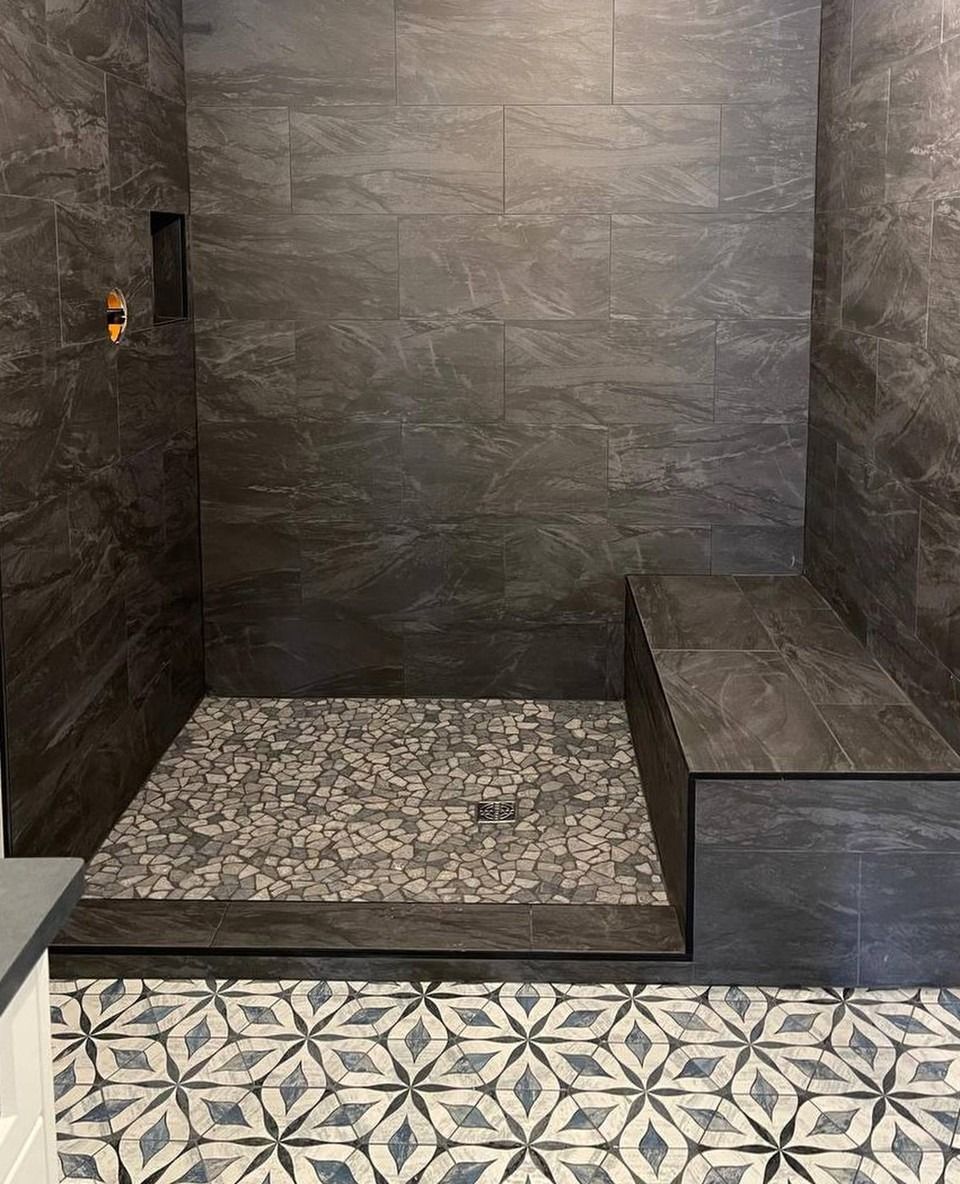
- A low curb, or none where the floor allows it. Going without a curb usually means recessing the floor so water still runs to the drain, which isn’t possible on every floor, so we’d check yours on site.
- A tiled bench, so there’s somewhere to sit.
- Small mosaic on the floor. All those joints give feet more grip.
- Solid backing in the walls before the board and tile go on, so grab bars have something to hold.
- A recessed niche at a comfortable height, so nobody has to bend or reach.
Getting started
Send us a photo of the bathroom and tell us who the shower is for. We’ll come by, measure and put the price in writing. See how we build showers.