
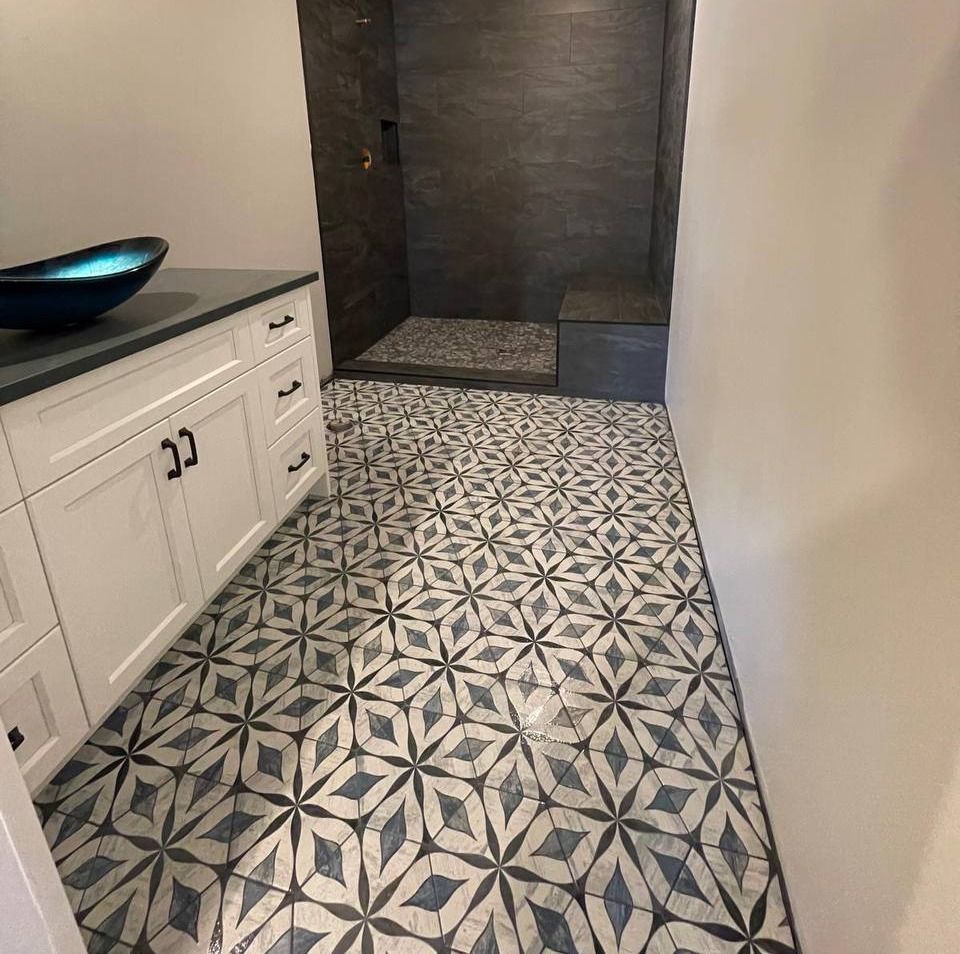
Clay that moves
The clay under Winnipeg swells when it’s wet and shrinks when it’s dry. A 1986 University of Manitoba engineering thesis described most single-family houses in the city as sitting on shallow footings over this clay. About 94 percent of the houses it surveyed had some damage (cracks, uneven floors, distorted door frames), most of it minor.
Commercial buildings here commonly sit on piles, and houses vary. A basement slab can crack and shift even when the walls hold still. Tile doesn’t flex, so if the floor under it moves, that movement goes straight into the joints and the tile.
What helps
- Check the floor first. A long straightedge, a look at the door frames and any cracks in the slab tell you a lot before anything is bought.
- Uncouple the tile. A membrane between the slab and the tile absorbs small sideways movement and hairline cracks. It won’t save tile from a slab that lifts or drops.
- Leave room to move. Soft joints at the walls and across large areas, filled with flexible sealant instead of grout, give the tile room to expand and shift.
None of this fixes a foundation. If a basement floor is actively heaving or the cracks keep growing, have it looked at before you spend money on tile. If we see that when we come to measure, we’ll tell you.
Long, cold winters
Tile feels cold because it pulls heat out of your feet faster than wood or carpet does. In a Winnipeg winter, a bathroom or basement floor can feel like that for months.
Electric heating mats help, and they add very little height. On a basement slab, ask about insulation under the mat, or the slab pulls the heat away. Your electrician connects the mat to a thermostat, so decide before floor prep starts. The circuit and thermostat location need planning.
Salt and meltwater at the door
From the first snow to the spring melt, sand, salt and meltwater end up on every entry floor in the city. That’s where the choice of tile matters most.
- Porcelain is dense. To carry the name under the North American standard, it has to absorb 0.5 percent water or less, so salty meltwater has little way in.
- Natural stone is more porous than porcelain. It needs sealing and regular upkeep.
- Polished tile and meltwater are a slippery combination. For an entry, we’d steer you toward a matte or textured finish.
- Grout is the weak spot. Seal cement grout, or ask about a stain-resistant one, and wipe up salt instead of letting it sit.
Can tile go in during winter?
Yes. Interior tile work runs all year. What matters is heat. Most mortars and grouts need the room and the floor above roughly 10 °C while they cure, so in a new build or an unheated addition, the heat has to be on before we start.